New Field Study Tracks Lake-Ice Melt and Collapse to Improve Ice-Model Accuracy
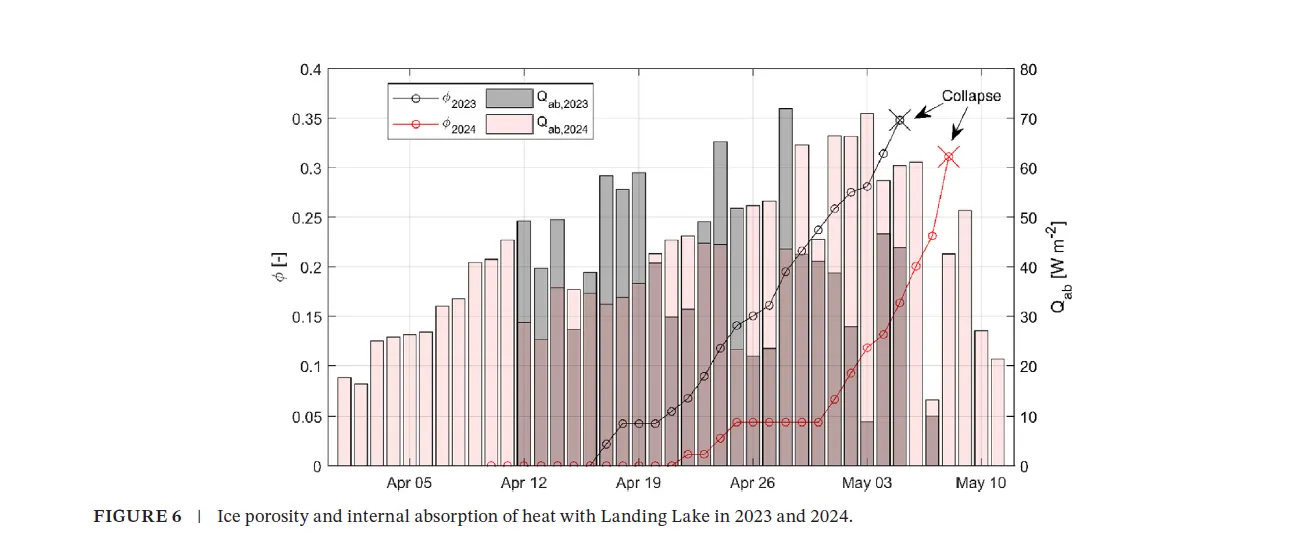
The new publication led by PhD student, Arash Rafat, addresses a major gap in cold-regions science: the lack of direct, in-ice measurements during the dangerous spring melt period. Using a Floating Research Station on Landing Lake near Yellowknife, Canada, to monitor snow, ice, and water conditions continuously and quantify the heat-budget drivers of ice decay across three melt seasons (April–May, 2023–2025). The study finds that lake-ice loss is driven by both thermal melt and mechanical collapse. Mechanical decay occurs once internal ice porosity reaches a critical range , contributing roughly 24%-48% of total ice loss. By providing rare, high-resolution observations during melt and break-up, the study offers practical evidence to refine how models represent albedo evolution, internal melt/porosity, and collapse thresholds, improving simulation reliability for high-latitude lakes and related hydrological and climate applications.
Read the full article here